Hours
| Sunday | 12:00 PM – 5:00 PM |
| Monday | 10:00 AM – 6:00 PM |
| Tuesday | 10:00 AM – 6:00 PM |
| Wednesday | 10:00 AM – 6:00 PM |
| Thursday | 10:00 AM – 6:00 PM |
| Friday | 10:00 AM – 6:00 PM |
| Saturday | 12:00 PM – 5:00 PM |
Closed on statutory holidays.

Richmond BC, Canada #richmondartgallerybc
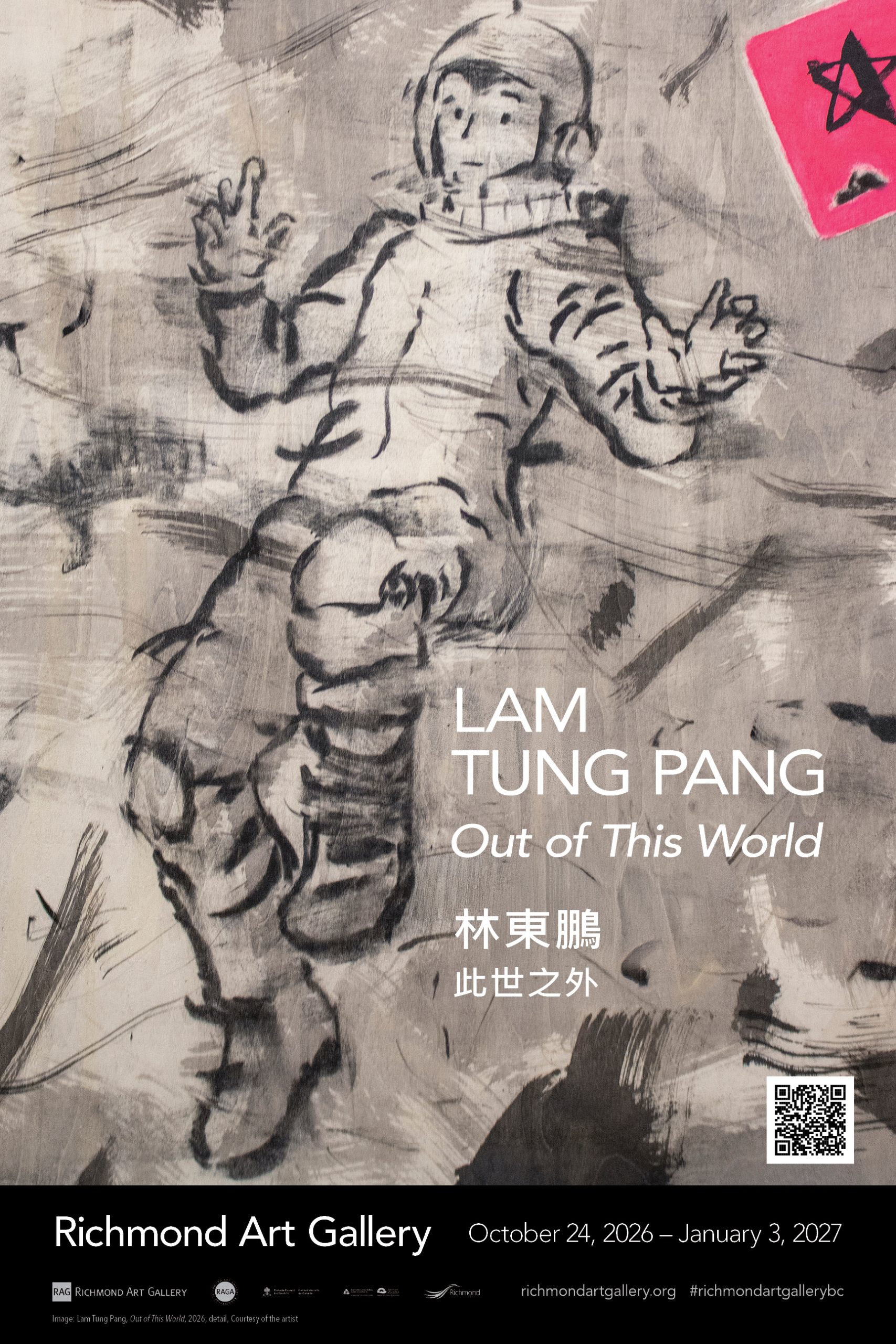
For his first solo exhibition in Canada, Lam Tung Pang presents a multifaceted body of work that spans the three-and-a-half years since his move from Hong Kong to Richmond. Since relocating, Lam has been developing a new visual vernacular that reflects the deconstruction and reconstruction of his own sense of self. Rooted in the intimate realities of leaving home and beginning again, his work speaks to the broader human experience of migration and belonging across today’s shifting global landscape. With a practice that has spanned Hong Kong, London, Beijing, and Vancouver, Lam is part of a global movement of artists navigating transnational lives.
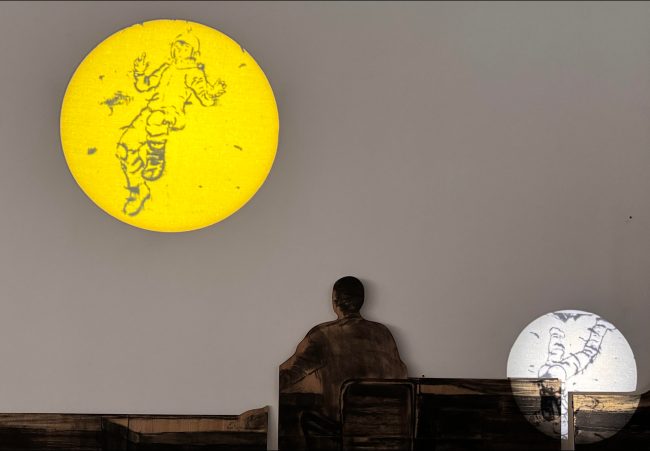
Embodying a playful yet poetic style, Lam’s expansive exhibition Out of This World layers drawings, paintings, slide projections, and video to transform the gallery into shifting fields of light and shadow. The immersive, site-specific installation juxtaposes empty domestic interiors—staircases, rooms, windows, furniture—with clips of iconic Canadian landscapes filmed during a road trip and the unbound vastness of outer space. A vital part of his lexicon, Lam’s landscapes are visual metaphors for the many layers that constitute one’s sense of place, from personal memories to national narratives. The collision of inner and outer worlds captures Lam’s own shifting artistic imaginary, inviting visitors to recall their own movement between the comfort of familiarity and the freedom of the unknown. Out of This World is both spatial and temporal in thrust: a cosmos of precarious dwellings and drifting landscapes, illuminated by the flicker of shifting eras, where analog warmth and digital immediacy coexist in uneasy suspension, gently unsettling the sense of the present.
The evocative figure of the astronaut—a recurring hand-drawn motif in Lam’s corpus—functions as a proxy for Lam himself. Drifting between countries, cultures, and languages, his trajectory is imbued with feelings of instability, disillusionment, melancholy, and nostalgia, alongside those of transformation, adventure, curiosity, and discovery. In this profoundly existential work that is shaped but not constrained by politics, geography, or history, Lam traces the structure of a dwelling—a house not quite a home, a site full of potential, awaiting gestures of imagination and invention.