Hours
| Sunday | 12:00 PM – 5:00 PM |
| Monday | 10:00 AM – 6:00 PM |
| Tuesday | 10:00 AM – 6:00 PM |
| Wednesday | 10:00 AM – 6:00 PM |
| Thursday | 10:00 AM – 6:00 PM |
| Friday | 10:00 AM – 6:00 PM |
| Saturday | 12:00 PM – 5:00 PM |
Closed on statutory holidays.

Richmond BC, Canada #richmondartgallerybc
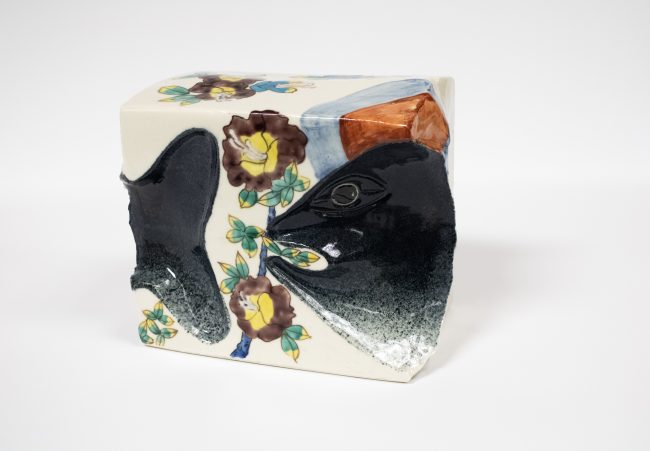
This compact, tactile ceramic work invites visitors to experience it from every angle. While deceptively simple, at closer glance it resembles an artifact unearthed from the ocean, with fossilized remains encased in stone over time. Wrapped around the piece’s slab-like form is the embedded figure of a fish and hand-painted and stylized sakura (cherry blossoms). This lyrical entwining evokes movement and emphasizes the work’s materiality and unusual shape. Sakura, a familiar motif in Japanese art, conjures images of spring, renewal, and abundance. The fish suggests not only sustenance but the cyclical rhythms of life. In the context of Richmond, it also represents a way of living deeply tied to the sea.
Through his skillful use of Japanese motifs and command of ceramic techniques—honed over the years in his homeland—Shigeno creates a silent prayer in clay, wishing prosperity for those who make their living from the water. Untitled is part of a quadriptych: a series of similarly formed sculptures, each varying slightly in ornamentation, reflecting on Steveston’s fishing history. In this successful repetition of clay firing, Shigeno demonstrates his precise proficiency with the ceramic medium. With this work, he pays tribute to Japanese Canadian master boatbuilders and fishermen who, despite profound discrimination, built an enduring and vital chapter of our local history.
Kinichi Shigeno was born in Ina, Japan, and trained in Seto, a city celebrated as Japan’s ceramic capital. His fascination with archaeological artifacts led him to discover ancient kiln sites in Mino, Seto, and Takaname. Three years after immigrating to Canada in 1981, he established a studio in Richmond, where he continues to work to this day.
Collection Close-up
Collection Close-up is an ongoing initiative highlighting works from the Permanent Collection that share a formal or thematic connection with the Gallery’s featured exhibition. This piece was selected for its links with Japanese contemporary art practices, international exchange, and the Japanese cultural presence in BC. These connections link it to the exhibition Ongoing Pacific Crossings.
– Maria Filipina Palad